
 By Felipe Lescure, CEO — RIGGING TECH
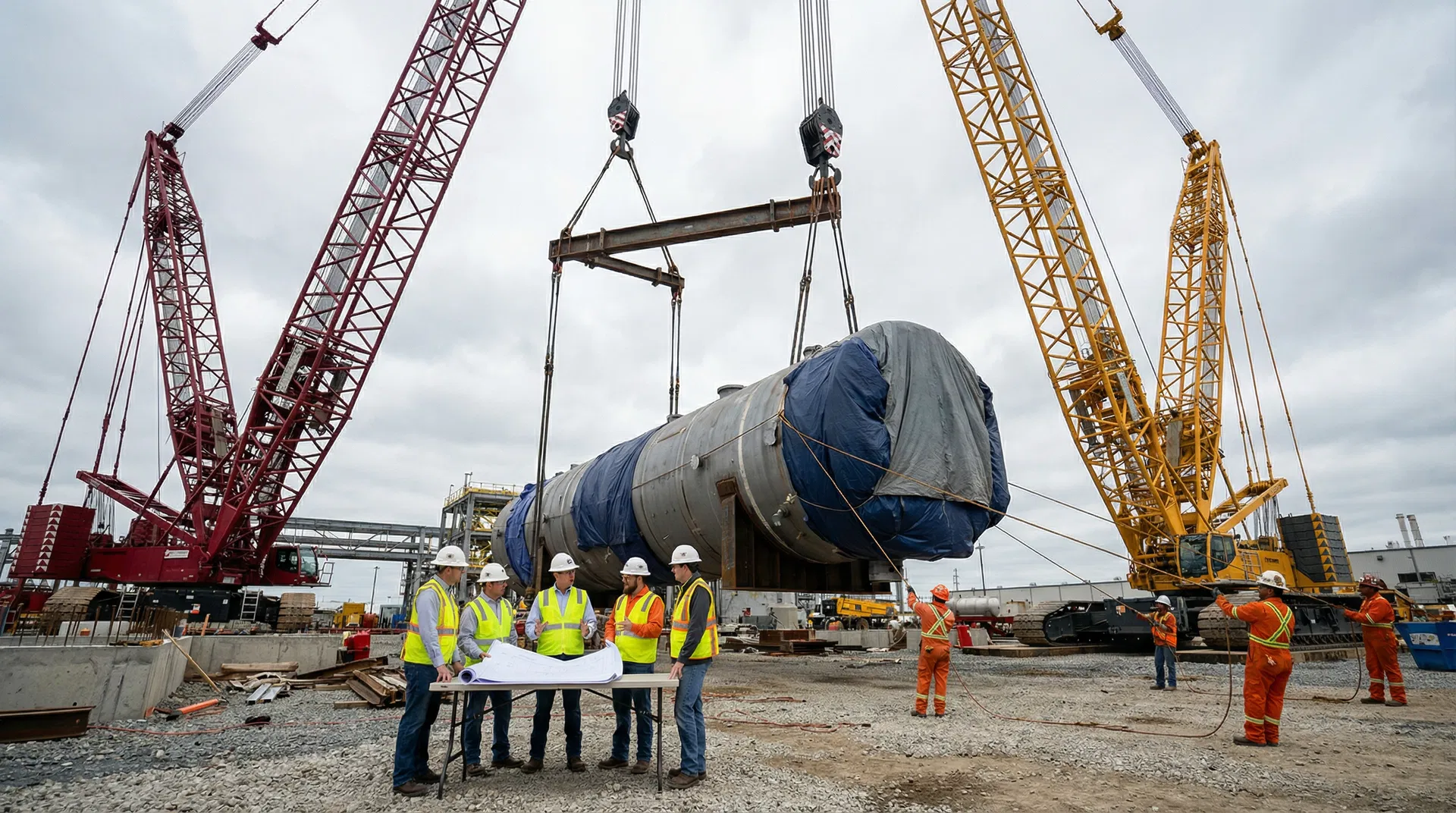
A critical lift is defined as any lifting operation that exceeds 75% of the crane's rated capacity, involves multiple cranes operating in tandem, lifts over live process equipment, or presents an elevated risk due to the load's value, complexity, or proximity to personnel. These operations demand a level of engineering rigor and planning precision that goes far beyond routine lifting procedures.
1. Defining a Critical Lift: When Standard Procedures Are Not Enough
The classification of a lift as "critical" triggers a cascade of additional engineering, planning, and approval requirements. While definitions vary between operators and regulatory frameworks, the most widely accepted criteria include lifts exceeding 75-80% of the crane's rated capacity at the planned radius, tandem lifts using two or more cranes, lifts over occupied areas or live production equipment, and operations involving loads of exceptional value or irreplaceable nature.
The consequences of failure during a critical lift are, by definition, severe. This is why the planning process for critical lifts must be led by qualified rigging engineers, reviewed by independent technical authorities, and approved by senior management before execution is authorized.
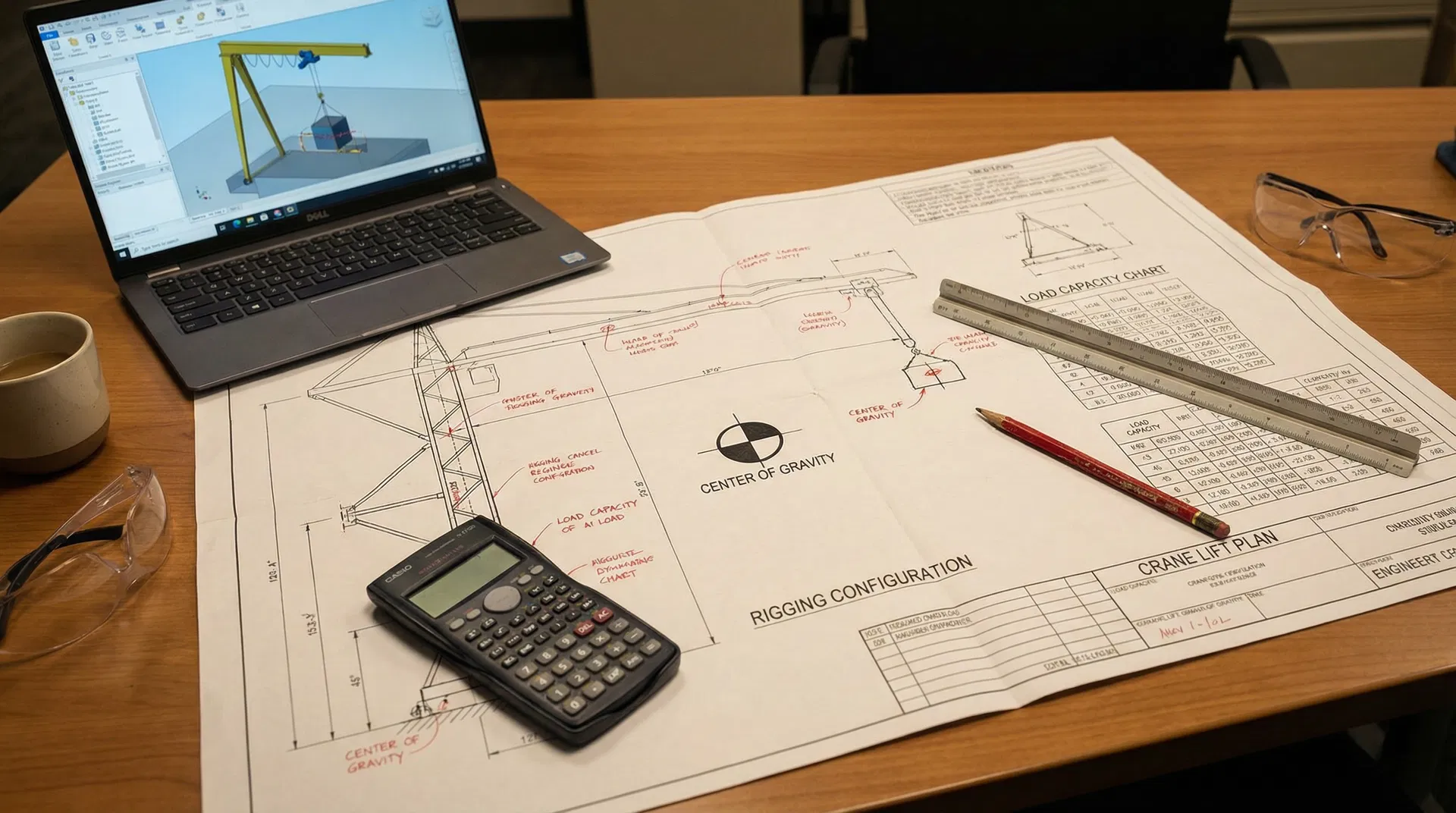
Detailed rigging plan with crane configuration, center of gravity calculations, and load capacity charts.
2. Step 1 — Load Analysis and Center of Gravity Determination
The foundation of every critical lift plan is an accurate understanding of the load. This begins with the verified weight — not the estimated, nameplate, or "as-designed" weight, but the actual weight confirmed through weighing, shipping records, or detailed engineering calculation that accounts for all attachments, fluids, and modifications.
Equally important is the precise determination of the center of gravity (CoG). For symmetrical loads, the CoG may be calculated from engineering drawings. For asymmetrical or complex loads, physical testing (tilt testing or suspension testing) may be required. An error in CoG determination can result in uncontrolled load rotation during the lift — one of the most dangerous scenarios in critical lifting operations.
3. Step 2 — Crane Configuration and Capacity Analysis
For critical lifts, the crane configuration analysis must be exhaustive. This includes verifying the crane's rated capacity at every point along the planned lift path — not just at the pick and set positions, but at every intermediate radius the boom will traverse during the operation. The analysis must account for boom deflection, counterweight configuration, outrigger loading (for mobile cranes), and any derating factors specified by the crane manufacturer.
| Analysis Element | Description | Standard Reference |
|---|---|---|
| Load Chart Verification | Capacity at all radii along lift path | Crane OEM specifications |
| Ground Bearing Pressure | Outrigger/track loading vs. soil capacity | ASME B30.5 / EN 13000 |
| Dynamic Amplification Factor | Motion-induced load increase (offshore) | DNV-ST-N001 |
| Boom Deflection | Structural deflection under load | Crane OEM specifications |
| Wind Loading | Lateral force on load and boom | ASCE 7 / EN 1991-1-4 |
| Tandem Lift Load Sharing | Load distribution between cranes | ASME B30.5 / DNV-OS-H205 |
4. Step 3 — Rigging Design and Engineering
The rigging design for a critical lift must be engineered — not simply selected from standard configurations. This involves calculating sling tensions at the planned sling angles, verifying that all hardware (shackles, links, swivels) is rated for the calculated loads with appropriate safety factors, and designing any custom lifting devices (spreader beams, lifting frames, trunnions) with full structural analysis.
For tandem lifts, the rigging design must account for load sharing between cranes. Even small differences in crane speed, boom angle, or rigging geometry can cause one crane to temporarily carry a disproportionate share of the load. The rigging plan must define the acceptable load-sharing tolerance (typically \u00b15-10%) and include provisions for monitoring and adjusting load distribution during the lift.
5. Step 4 — Risk Assessment and Mitigation
A formal risk assessment is mandatory for all critical lifts. This assessment must identify all credible failure modes — including equipment failure, human error, environmental exceedance, and ground/foundation failure — and define specific mitigation measures for each. The risk assessment should use a structured methodology such as HAZID (Hazard Identification), bow-tie analysis, or a quantitative risk assessment (QRA) for the most complex operations.
"In critical lift planning, the question is never 'what could go wrong?' — it is 'what have we done to ensure that every identified risk has been reduced to As Low As Reasonably Practicable (ALARP)?'"
6. Step 5 — Documentation, Review, and Approval
The critical lift plan document must be comprehensive and self-contained. It should include the lift description and objectives, load data and CoG location, crane configuration and capacity analysis, rigging design with calculations, environmental limits, personnel roles and competency requirements, communication protocols, emergency procedures, and a step-by-step execution sequence.
Before execution, the plan must undergo independent technical review — ideally by a qualified engineer who was not involved in the plan's development. Many operators also require third-party verification by an accredited inspection body (such as DNV, Lloyd's, or Bureau Veritas) for the highest-risk critical lifts. Final approval is typically granted by the installation's Operations Manager or equivalent authority.
7. Step 6 — Execution and Monitoring
Execution of a critical lift follows the approved plan with zero tolerance for deviation. A comprehensive pre-lift briefing ensures all personnel understand their roles, the sequence of operations, communication protocols, and abort criteria. The trial lift phase is extended for critical operations, with additional checks on load behavior, rigging geometry, and crane performance before the main lift proceeds.
For tandem lifts, real-time load monitoring using calibrated load cells on each crane is essential. The Lifting Supervisor monitors load distribution continuously and has the authority to halt the operation immediately if load sharing deviates beyond the defined tolerance. All critical lift operations should be documented with photographs and, where practical, video recording for post-operation review.
Conclusion
Rigging planning for critical loads is the ultimate expression of engineering discipline in the lifting industry. It requires the integration of structural analysis, mechanical engineering, risk management, and operational expertise into a single, coherent plan that leaves nothing to chance. The investment in thorough planning is always justified — because in critical lifting, the cost of failure is measured not in dollars, but in lives.
RIGGING TECH's engineering team brings decades of experience in planning and executing critical lifts for the Oil & Gas industry, from FPSO module installations to subsea equipment deployments. Our rigorous methodology, combined with digital tools like PILO\u2122, ensures that every critical lift we plan meets the highest standards of safety and engineering excellence.
Need a Critical Lift Plan?
RIGGING TECH provides comprehensive critical lift planning services, from initial feasibility studies through detailed engineering, third-party verification support, and on-site supervision. Contact our engineering team to discuss your next critical lifting challenge.
Contact our team